

The Crumbles journal
Vegan crumble: replacing butter without losing the crunch (fats, binders, toppings)
A crumble is almost vegan already. Only butter and dairy toppings stand in the way. We break down what butter does, and which plant-based fat fills each role.
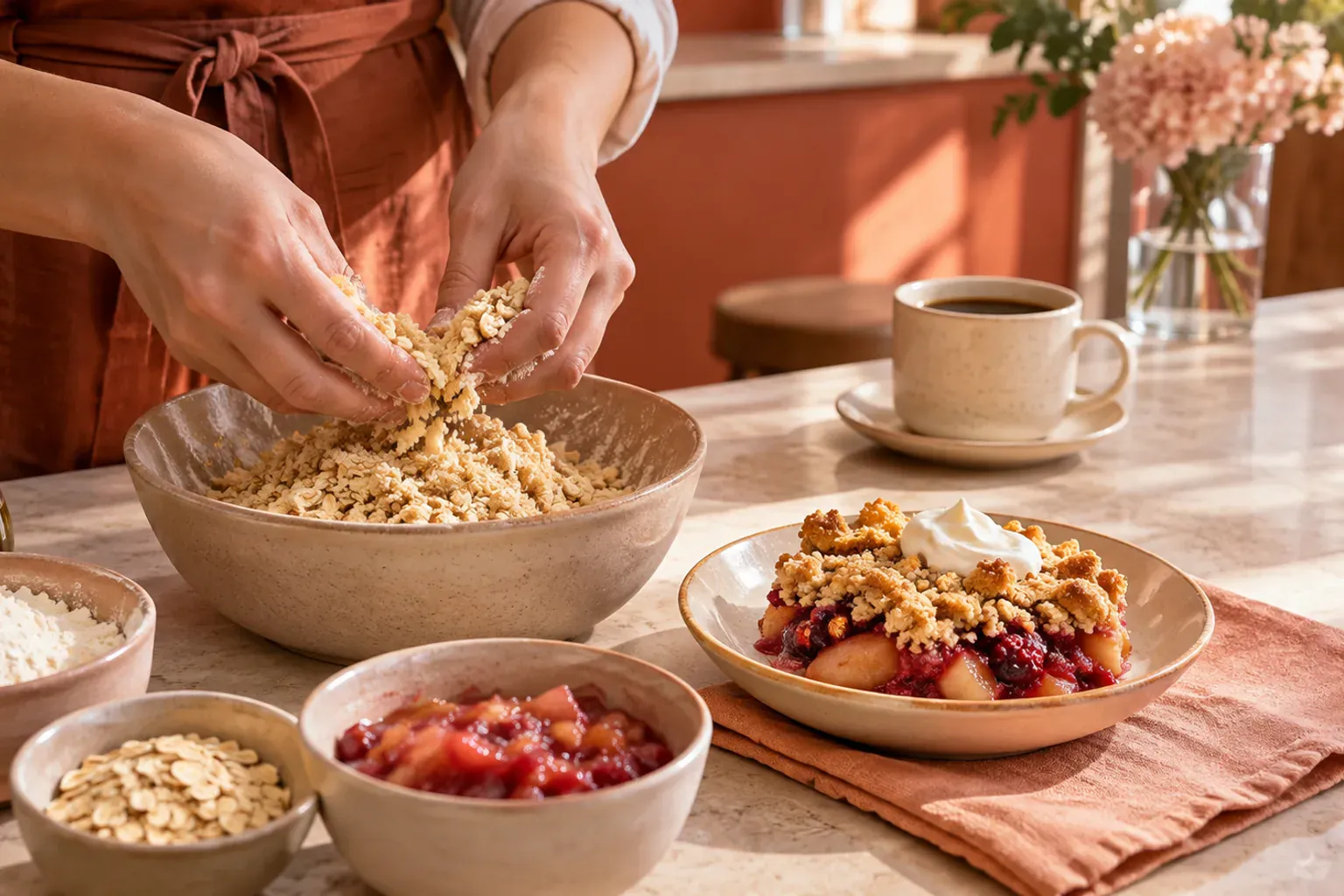
Fruit, flour, sugar: a crumble is almost vegan by nature. Only butter and dairy toppings (custard, whipped cream) are a problem.
This is the plant-based take on our homemade apple crumble recipe, built “by function”: what butter does, and which substitute fills each role.
We then apply it to the four steps of composition: fruit, base, toppings and crumblings.
What butter really does in a crumble topping
Butter does several jobs at once; few substitutes do them all.
Rubbing in: coating flour to get crumbs, not dough
Fat coats the flour so you get coarse crumbs rather than smooth dough. Solid fats do this best.
Flavour and browning (Maillard, nutty notes)
Milk proteins brown in the oven. Compensate with brown sugar, ground almonds and a pinch of salt.
Why cold fat makes crunchier crumbs
Cold fat stays in small pieces that melt in the oven and leave tiny air pockets. Warm fat makes a dense slab.
What to replace butter with in a vegan crumble: the comparison
Four families of plant fats work. Ratios are starting points per 100 g of flour.
Block vegan butter / margarine
The closest substitute. Pick a baking block, not a watery spread.
Starting ratio
60–70 g per 100 g flour
Refined coconut oil
The crunchiest. Use it cold, grated or diced.
Starting ratio
50–55 g per 100 g flour
Liquid oils (rapeseed, mild olive)
Drizzle into the dry mix and rub between your palms. Use less.
Starting ratio
40–45 g per 100 g flour
Nut butters (almond, hazelnut, cashew)
Flavour and binding; pair with a little oil.
Starting ratio
35–40 g + 15 g oil per 100 g flour
Summary table: crunch, flavour, ease, cost, ratio per 100 g of flour
| Substitute | Crunch | Flavour | Ease | Cost | Ratio / 100 g flour |
|---|---|---|---|---|---|
| Block vegan butter | Good | Neutral | Very easy | Moderate | 60–70 g |
| Refined coconut oil | Excellent | Neutral | Medium | Higher | 50–55 g |
| Rapeseed / mild olive oil | Fair | Neutral / fruity | Easy | Low | 40–45 g |
Start with block vegan butter, then mix families once you master the technique.
The basic vegan crumble topping: ratios and technique
A base for a medium dish, using block vegan butter.
For a medium dish
- 150 g flour
- 90–100 g cold block vegan butter
- 70 g brown sugar
- A pinch of salt
Technique
Mix the dry ingredients
Flour, sugar, salt.
Rub in with fingertips
Quickly, until coarse crumbs form.
Chill 20 minutes
The crumbs set and hold in the oven.
Scatter without pressing
Air between crumbs means crunch.
For baking, follow our homemade apple crumble recipe; vegan topping browns a little slower, so judge by colour.
Varying the base: oats, ground almonds, wholemeal sugar, hazelnuts
The base, step two of composition, makes up for the flavour butter no longer brings.
Oat flakes
More rustic crunch.
Ground almonds
Browns well.
Wholemeal sugar
Caramel notes.
Crumblings use the same topping, baked separately. See our guide Build your crumble for the four steps.
The fruit: nothing changes… almost
Most fruit works as is under a vegan topping.
For juicy fruit, bind the juice with a teaspoon of starch instead of butter.
In November, think autumn and winter fruit:
Apple
The safe bet.
Pear
Juicy: add starch.
Quince
Pre-cook longer.
See our article on seasonal fruit for the perfect crumble.
Vegan toppings: plant custard, coconut cream, butter-free caramel
Each dairy topping has a convincing plant-based twin.
Oat or soy milk custard thickened with starch (egg-free)
50 cl plant milk, 40–50 g sugar, 20 g cornflour, vanilla; thicken gently while whisking.
Coconut whipped cream: the chilled-can trick
Chill a can of full-fat coconut milk overnight, whip only the solid cream with icing sugar.
Coconut milk caramel
Dry caramel loosened with hot coconut milk and a pinch of salt.
These fit the four-step logic of Build your crumble: the beginner’s guide.
Mistakes that make a vegan crumble soggy or greasy
Four common mistakes, all easy to fix.
Too much oil
Stick to 40–45 g per 100 g flour.
Warm fat
Everything straight from the fridge.
Undrained fruit
Drain and bind with starch.
Packed topping
Scatter, don’t press.
For more troubleshooting, read our 5 secrets of a perfect homemade crumble.
Vegan AND gluten-free crumble: is it possible?
Yes. The challenge becomes the flour: pick your gluten-free blend first, then replace the butter as above.
And at Crumbles?
At 3 rue Pierre Fontaine, everything is homemade, with organic Île-de-France flour and seasonal French fruit.
Some bases can be adapted depending on the day: ask at the counter for today’s options.
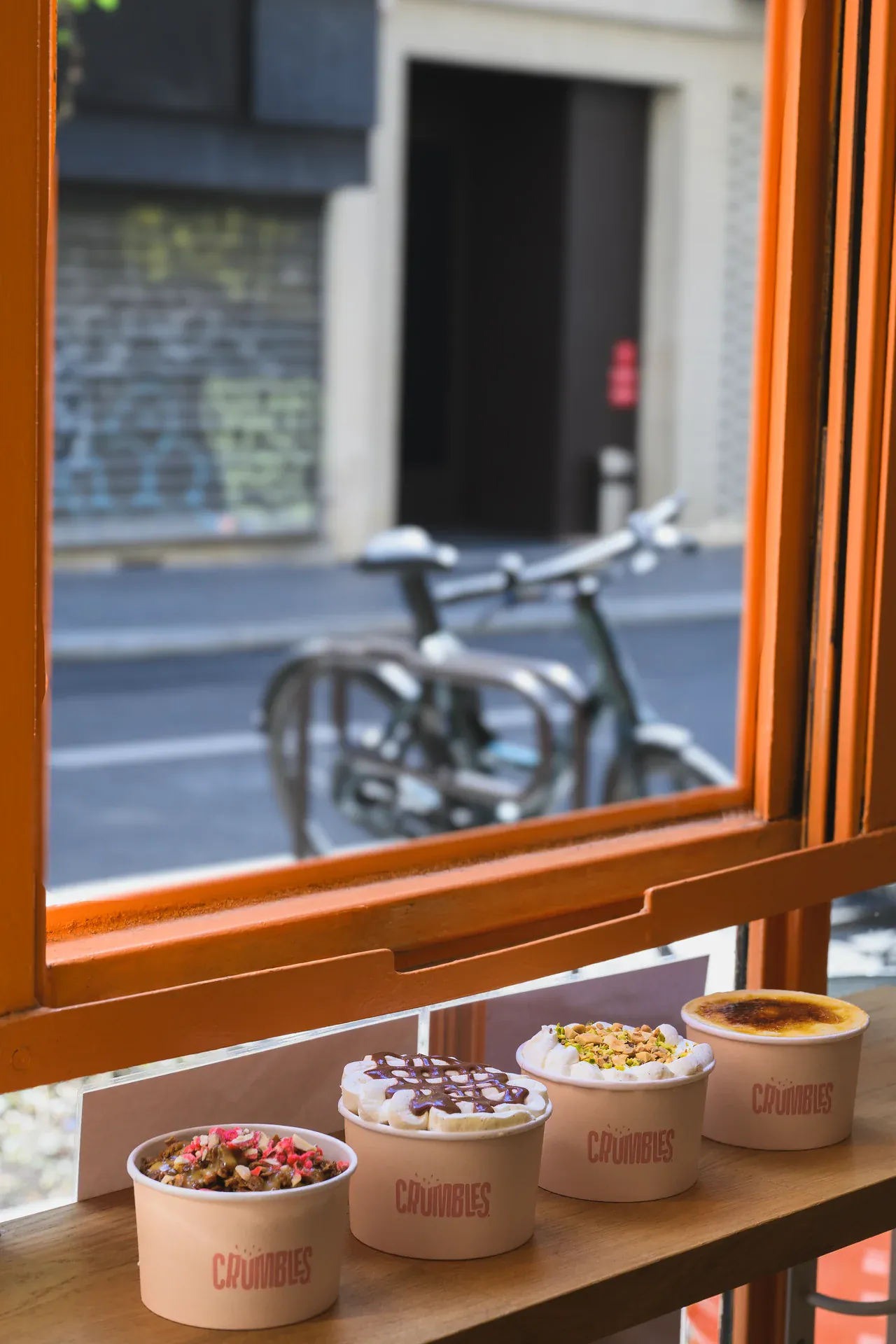
A plant-milk latte pairs nicely; see which drink with a crumble.
Want a taste before trying it yourself? Come build your crumble on rue Pierre Fontaine (Paris 9th) and ask about today’s possible adaptations.
Frequently asked questions
FAQ
Is a crumble vegan?
Not classically: the topping uses butter and is often served with dairy custard. Everything else is plant-based.
What can replace butter in a crumble?
Block vegan butter (60–70 g per 100 g flour), refined coconut oil (50–55 g), liquid oil (40–45 g) or nut butters, always cold.
Can you make a crumble with olive oil?
Yes, with a mild olive oil at 40–45 g per 100 g of flour.
Does coconut oil taste of coconut?
Virgin coconut oil does; refined coconut oil is almost neutral.
How do you make vegan custard?
Heat oat or soy milk with sugar and vanilla, thicken with cornflour.
Can vegan crumble be frozen?
Yes; see our 5 secrets of a perfect homemade crumble for freezing and reheating.
Read also
Going further
For the starting base we adapt here, head back to our apple crumble recipe.